static version of Safeways map
Latest Issues

Walk Toronto a partner in SafewaysTO map initiative

Walk Toronto has joined with Cycle Toronto, The Bentway, Park People, and Spacing Magazine to offer Torontonians a map of an emerging network of vital safe, linear public spaces or “safeways” (including slow streets and other ActiveTO closures, bike lanes, and multi-use trails), that provide city-dwellers expanded routes to navigate and enjoy safely on foot and by other forms of active transportation.

The map was created by Walk Toronto’s Sean Marshall, and it will be updated as new initiatives are announced by the city.

A static version of the map (up to June 4, 2020) is also available.
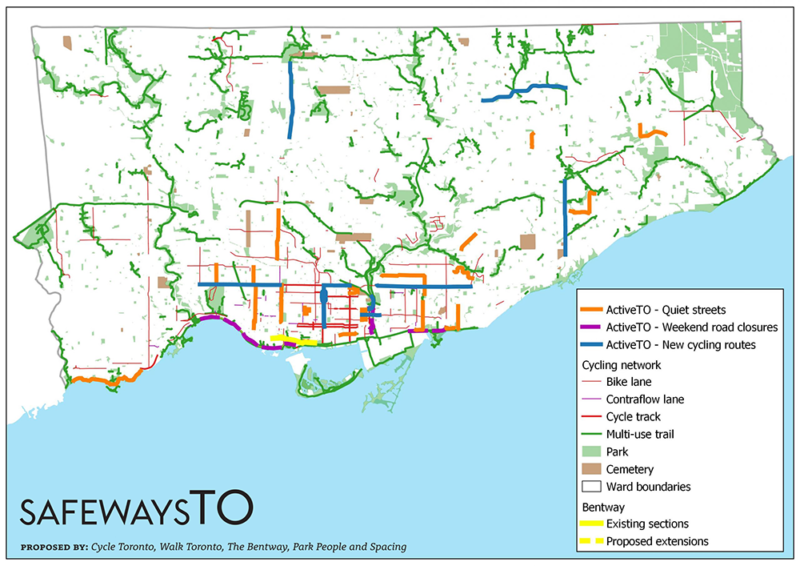
SafewaysTO map

Latest Issues

Walk Toronto writes to Medical Officer of Health to identify sidewalk crowding locations

Walk Toronto has written to Dr. Eileen de Villa, Toronto’s Medical Officer of Health, with a list of locations where long and persistent lineups or obstructions have resulted in sidewalk crowding that makes it impossible for pedestrians to follow the physical distancing recommendations for stopping the spread of COVID-19.

The locations were crowdsourced by Walk Toronto from our steering committee and from our followers on social media. They were collected in a spreadsheet, and have also been posted on Google Maps.

Our letter is a response to an invitation by the City of Toronto’s Medical Officer of Health to identify locations where sidewalks are being crowded due to lineups, and to the action by the City of Toronto to open a curb lane to pedestrians at a pizzeria with long and persistent lineups. It is our hope that the City of Toronto will use this information to identify further locations where a curb lane should be closed to vehicles in order to enable pedestrians to maintain the recommended physical distance.

Latest Issues

Walk Toronto writes to mayor to support opening curb lanes for pedestrians for physical distancing

Walk Toronto has written to Mayor John Tory to support implementing safe physical distancing measures on Toronto’s streets, echoing calls for temporary pedestrian and cycling infrastructure endorsed by Ryerson University professors and epidemiologists Anne Harris and Linda Rothman, among others. The measures would involve opening curb lanes on main streets for use by pedestrians, by closing them to vehicle use, in order to enable pedestrians to keep 2 metres distance from each other where sidewalks are narrow or obstructed. The letter was written by Walk Toronto steering committee member Sean Marshall.

Latest Issues

Walk Toronto supports reducing right turns on red at Infrastructure and Environment Committee

Walk Toronto has submitted a letter to the Infrastructure and Environment Committee supporting councillor Mike Layton’s request to reduce the number of intersections where vehicle right turns are allowed on red lights.

The letter was drafted by Walk Toronto’s Daniella Levy-Pinto. Sean Marshall spoke to the item at the committee meeting.

“Walk Toronto supports reducing the number of intersections that allow right turns on red. However, we see this as just the first step. If Toronto Council is truly committed to the principles of Vision Zero — and if it is serious about following the example of peer cities such as Montreal and New York — then it will enact a city-wide, blanket prohibition of right turns on red.

Latest Issues

Walk Toronto deputes at Toronto Police Services Board regarding lack of enforcement of traffic safety

Walk Toronto’s Sean Marshall gave at deputation at the Toronto Police Services Board on Nov. 21, 2019 about about the lack of enforcement of traffic laws in Toronto and the proposal to reinstate a small traffic enforcement team.

Sean writes, “I spoke to express our disappointment of how the TPS completely failed vulnerable road users by not engaging in meaningful traffic enforcement and calling for a return to making this a priority.”

Read Sean Marshall’s thoughts and his full deputation.

Watch Sean Marshall’s deputation on YouTube.

Latest Issues

Walk Toronto submits comments on sidewalk snow plowing and safe access to TTC stops to Infrastructure and Environment Committee

Walk Toronto submitted written comments on two items at the October 17 meeting of the City of Toronto’s Infrastructure and Environment Committee (IEC).

The first communication, written by Daniella Levy-Pinto with contributions from Michael Black, addressed the Winter Maintenance Program Review, which was commissioned in response to the lack of sidewalk snow plowing and other issues brought to light during the winter months of 2019.

While the Review promises some useful first steps in expanding sidewalk snow clearing to areas where it is currently lacking, Walk Toronto’s letter emphasizes the need for stronger steps that lead to comprehensive, harmonized levels of service for sidewalk snow clearing in all parts of the city.

The second communication, written by Dylan Reid, addressed the staff Update on Council Requested Road Safety Initiatives, specifically the staff response to Walk Toronto’s recommendation, adopted for study by the IEC at an earlier meeting, that the City adopt a policy that there should be a safe road crossing at all TTC stops.

The staff report (PDF, pp. 4-6), while noting that there are an astonishing 2,700 TTC transit stops at locations without traffic control, rejects this policy proposal and largely claims that existing measures are sufficient to address safety needs. Walk Toronto argues to the contrary that “In a city that claims to be committed to Vision Zero, identifying this large number of dangerous stops is surely a call to action, not an excuse for inaction.”

Latest Issues

Walk Toronto submits comments to the Province regarding e-scooters

In response to a call from the Government of Ontario for comments regarding kick-style electric scooters (e-scooters), Walk Toronto submitted comments to the Province regarding this issue, prepared by Walk Toronto steering committee member Judith Kidd.

Walk Toronto’s recommendations were concerned with ensuring safety for pedestrians:

1. Prohibit e-scooters on sidewalks;
2. Reduce the power from 500W motors, the speed from 32km/h, and the weight from 45 kg. Speeds should be restricted to 25 km/hr or lower to make their speed more comparable with bicycles and other devices that use bike lanes;
3. Require devices to be audible when ridden so that others sharing the road are aware of their presence;
4. Minimum operating age should be 18, in line with other jurisdictions that permit e-scooters;
5. Ensure that e-scooters cannot be left loose on the sidewalk, but rather are required to have designated docking stations. We are opposed to any system where riders can leave a scooter in any location. It is dangerous for people who are visually impaired or blind.
6. Explore the need for liability insurance in the case of collisions with cyclists or pedestrians.
7. Explore the addition of regulations regarding distracted operation of e-scooters .

Read the full submission here (PDF)

Latest Issues

Reduce the default speed limits, says Friends and Families for Safe Streets and Walk Toronto

Walk Toronto has joined Friends and Families for Safe Streets in calling for the City of Toronto’s Vision Zero 2.0 plan to include a reduction in the default speed limit on arterial streets to 40 km/hr and on local streets to 30 km/hr.

Nearly all serious injuries and deaths (83%) happen on arterial roads. We know that when adriver hits a pedestrian at 50 km/h, there is an 85% likelihood that the impact will kill thepedestrian. The fatality rate falls to 30% at speeds of 40 km/h. Not only does lowering the speedlimit to 40 km/h drastically improve someone’s chances of surviving a collision, but driving at alower speed can help avoid collisions entirely.

Latest Issues

Walk Toronto opposes proposal to study legalizing cycling on sidewalks

Walk Toronto has written to Toronto City Council to ask it to reject a proposal being presented to City Council to study legalizing adult cycling on sidewalks on some suburban arterial roads.

Walk Toronto argues that cycling on sidewalks introduces a new set of collision risks for both cyclists and pedestrians. Legalizing bicycle riding on sidewalks will make sidewalks less safe, attractive and convenient for pedestrians. The best solution is to build safe, separated bike lanes on suburban arterial roads. Walk Toronto’s submission goes into a detailed discussion of the issues involved.

Crowd at Yonge and Dundas
Events

Walk Toronto leading Yonge Street walk at Open Streets

Please join Walk Toronto during Open Streets 2019, on Sunday August 18 and Sunday September 15, for a walk up Yonge Street to discuss its history, its potential transformation into a pedestrian-oriented street, and various other pedestrian issues.

The walk will be led by Sean Marshal and other members of Walk Toronto’s steering committee. The walk will take approximately 2 hours.

Dates: Sunday August 18 and Sunday September 15, 2019

Time: Meet at 11:00 am

Meeting Point: South of Yonge and Shuter Streets, near the Elgin Theatre

New residential and commercial developments are bringing many more people downtown, and many of those people walk, cycle, or take transit, rather than drive. Yonge Street, despite the crowds, was designed for drivers, rather than the majority of users, but now there is an opportunity to change that situation with the City of Toronto’s Yonge TOmorrow initiative.